

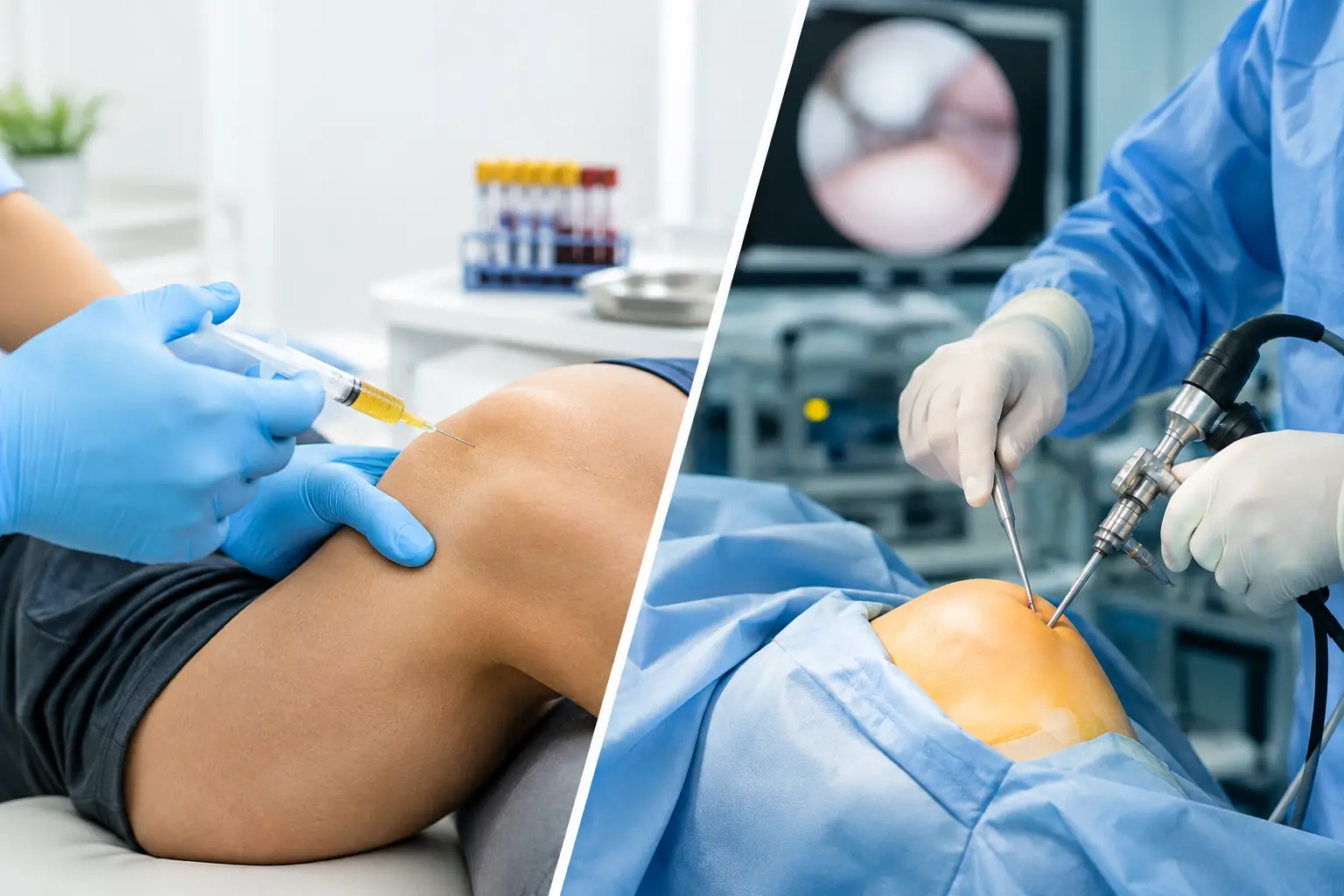
A painful knee, shoulder, hip, or tendon injury can make every decision feel urgent. Yet PRP injections vs surgery is rarely a simple choice between a quick procedure and an operating room. The right path depends on what is structurally happening in the joint, how long symptoms have been present, what treatments you have already tried, and what you need to return to in daily life.
For many people, the most useful first step is not choosing a treatment. It is getting a comprehensive assessment that identifies the true source of pain, mobility loss, weakness, or instability. A coordinated strategy can help determine when a regenerative option may support healing and when a surgical opinion is necessary to protect long-term function.
PRP Injections vs Surgery: The Core Difference
Platelet-rich plasma, commonly called PRP, uses a concentrated portion of your own blood that contains platelets and growth factors. After a blood draw, the sample is processed and injected into a targeted area, such as an arthritic joint, irritated tendon, or ligament injury. The goal is to support the body’s healing response in tissue that may have limited blood supply or has not improved with basic conservative care.
Surgery takes a different approach. It may repair, reconstruct, remove, or replace damaged tissue. Depending on the condition, surgery can address problems that an injection cannot physically correct, such as a complete tendon rupture, significant joint instability, a displaced fracture, or advanced structural damage.
Neither option is automatically “better.” PRP may be a thoughtful option when pain is related to inflammation, degeneration, or a partial soft-tissue injury and there is still a reasonable structure to preserve. Surgery may be the more appropriate recommendation when imaging and examination show a mechanical problem that requires repair.
When PRP May Be Worth Considering
PRP is often considered after a patient has tried appropriate first-line care, such as activity modification, physical rehabilitation, chiropractic care when appropriate, anti-inflammatory strategies, or other conservative measures. It may be used for certain cases of knee osteoarthritis, tennis or golfer’s elbow, plantar fasciitis, Achilles or patellar tendon concerns, and some shoulder or hip pain patterns.
The best candidates are not defined by age alone. A physically active adult with an early degenerative knee condition may be a strong candidate, while an older adult with similar symptoms may also benefit if the joint is stable and the treatment plan is realistic. The key questions are whether the diagnosis fits, whether the tissue can respond, and whether PRP supports the person’s broader recovery goals.
PRP can appeal to patients because it is less invasive than surgery and usually involves less downtime. Most people can go home the same day. However, less invasive does not mean effortless. Soreness and a temporary symptom flare can occur after treatment, and improvement typically develops gradually over weeks to months rather than overnight.
Results also vary. PRP is not a guaranteed fix for arthritis or an injury, and protocols can differ based on the body area and clinical goal. A responsible recommendation should account for the severity of tissue damage, medication use, medical history, movement patterns, nutrition, sleep, and the rehabilitation plan that follows the injection.
When Surgery Should Move Higher on the List
A procedure may be necessary when the body needs more than biological support. PRP cannot reconnect a completely torn tendon, stabilize a severely damaged ligament, remove a loose body blocking joint movement, or reverse end-stage joint collapse.
Surgery may be more strongly considered when pain is paired with significant loss of function, repeated giving way, locked joint motion, deformity, or a clear structural injury on imaging. In these situations, delaying an orthopedic evaluation can sometimes lead to additional damage or a more difficult recovery.
Seek timely medical evaluation for symptoms such as:
- A sudden inability to bear weight or use the affected limb
- A visibly deformed joint or severe swelling after trauma
- A joint that locks, repeatedly gives out, or cannot fully move
- Fever, redness, warmth, or rapidly worsening pain around a joint
Surgery also has real trade-offs. Recovery can involve anesthesia, incisions, rehabilitation, time away from work or activity, and risks such as infection, blood clots, stiffness, or persistent pain. Those considerations do not mean surgery should be avoided when it is indicated. They mean the decision deserves a clear diagnosis and a conversation about expected function, recovery demands, and alternatives.
The Gray Area: Conditions That Need Individualized Planning
Many patients fall between obvious non-surgical care and obvious surgical repair. A partial rotator cuff tear, moderate knee arthritis, meniscus symptoms, chronic tendon pain, or persistent hip pain may require more nuanced decision-making.
For example, a meniscus finding on an MRI does not always explain knee pain. Some tears are associated with mechanical locking and may need surgical consideration. Others occur alongside arthritis and may respond better to strengthening, load management, weight and metabolic support when relevant, injection-based care, and a targeted mobility plan.
The same principle applies to joint arthritis. PRP may help some patients manage symptoms and improve function, particularly earlier in the degenerative process. But it does not regrow a severely worn joint or replace the need for joint replacement when pain and mobility limits have become advanced. Honest care means discussing where a treatment may help and where its limits are likely to be.
A Better Decision Starts With the Right Assessment
Choosing between PRP and surgery should not be based on an advertisement, a friend’s outcome, or pain level alone. Pain can be intense even when surgery is not needed, and a relatively quiet injury can still require prompt repair. A thorough evaluation considers your symptom history, physical examination, movement and strength patterns, prior treatments, relevant imaging, and health factors that may affect recovery.
At Quad Cities Integrative Wellness, this process can also include the contributors that often complicate musculoskeletal recovery. Poor sleep, chronic stress, depression, nutritional gaps, metabolic dysfunction, hormone changes, and reduced conditioning can all influence pain sensitivity, inflammation, energy, and rehabilitation progress. Addressing these factors does not replace orthopedic care when surgery is necessary. It helps create a more complete recovery environment around the right treatment decision.
A coordinated plan may include regenerative joint interventions, chiropractic and mobility support, therapeutic exercise guidance, recovery-focused services, and referral for orthopedic evaluation when the findings call for it. Rather than treating an injection as a stand-alone answer, the goal is to match treatment intensity to the actual problem.
Questions to Ask Before Choosing PRP or Surgery
Before committing to either option, ask what diagnosis is being treated and how certain it is. Ask whether the issue is primarily inflammatory, degenerative, mechanical, or related to instability. You should also understand what the treatment can realistically improve, how long recovery may take, and what rehabilitation will be expected afterward.
It is reasonable to ask whether waiting carries a risk of worsening damage and whether PRP could delay a procedure without compromising the outcome. Conversely, if surgery has been recommended quickly, ask whether there are evidence-informed conservative or regenerative options that fit your specific injury. A second opinion can be valuable when the diagnosis or path forward remains unclear.
Your goals matter as much as the scan. Someone hoping to return to competitive sport may make a different choice than someone whose priority is walking comfortably, working without pain, or keeping up with family. The most appropriate plan aligns the condition, the evidence, the risks, and the life you want to get back to.
A careful assessment can replace the pressure to choose quickly with a clear path forward. Whether that path includes PRP, surgery, rehabilitation, or a combination over time, the right next step is the one that protects function while supporting your whole recovery.