
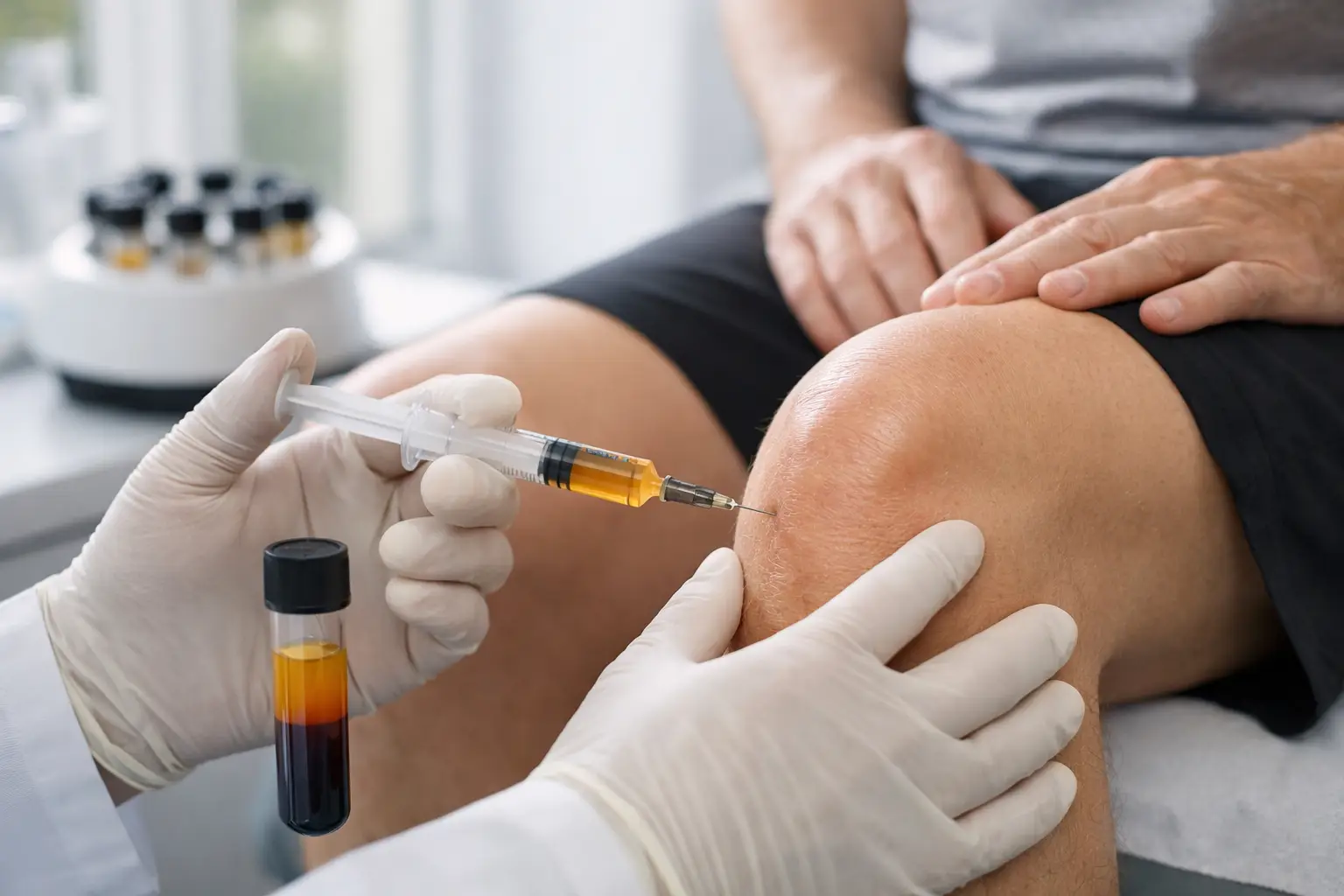
Knee pain has a way of shrinking your world. Stairs become a calculation. Workouts turn into recovery days. Even getting up from a chair can remind you that something in the joint is not functioning the way it should. For many patients, prp injections for knee pain become part of the conversation when rest, medications, and standard conservative care have not created lasting progress.
PRP stands for platelet-rich plasma. The treatment uses a sample of your own blood, processed to concentrate platelets and growth factors, then injected into the injured or irritated area of the knee. The goal is not to mask pain for a few hours. It is to support the body’s repair response in a more targeted way.
That distinction matters. Knee pain is often treated in a fragmented way, with one plan for inflammation, another for movement, and another for the stress that comes from living with pain. In reality, those issues overlap. A more useful approach is to ask why the knee is still hurting, what structures are involved, how your movement patterns may be contributing, and whether a regenerative option fits into a broader treatment strategy.
How PRP injections for knee pain work
Platelets are best known for helping blood clot, but they also carry signaling proteins that help coordinate tissue healing. In a PRP procedure, a provider draws your blood, places it in a centrifuge to separate and concentrate key components, and then injects that concentrated plasma into the knee.
The exact target depends on the problem being treated. Some patients have pain driven mostly by mild to moderate osteoarthritis. Others have patellar tendon irritation, ligament strain, cartilage wear, or ongoing inflammation after an old injury. A careful assessment helps determine whether the pain source is likely to respond to PRP or whether another path makes more sense.
PRP is not the same as a steroid injection. Steroids are designed to reduce inflammation quickly, which can be helpful in the right setting, but that is different from trying to stimulate a healing response. For some patients, that difference is the reason PRP is worth considering, especially when the goal is better function over time rather than temporary symptom suppression.
Who may be a good candidate
PRP is often considered for patients with knee pain that has lingered despite activity modification, physical therapy, bracing, chiropractic support, or standard medication-based care. It may be appropriate for people with early to moderate degenerative changes, overuse injuries, tendon-related pain, or instability tied to soft tissue strain.
It tends to be a better fit when there is still tissue capacity to support repair. If a knee is severely degenerated, structurally unstable, or mechanically blocked, PRP may offer limited benefit on its own. That does not mean the situation is hopeless. It means treatment selection needs to match the actual condition of the joint.
This is also why imaging and physical examination matter. Two people can both say, “My knee hurts,” while having very different root contributors. One may have patellofemoral tracking issues and muscle imbalance. Another may have meniscal irritation and osteoarthritis. Another may be dealing with pain amplified by chronic inflammation, poor recovery, excess body stress, or metabolic factors that are slowing healing.
A coordinated clinic looks at more than the knee in isolation. Sleep, inflammation load, body composition, hormone status, movement quality, and nervous system stress can all influence recovery. That whole-person lens does not replace local joint treatment. It improves how that treatment is used.
What the procedure is like
Most PRP appointments are straightforward. Your blood is drawn first. The sample is processed to isolate the platelet-rich portion, and the provider prepares the injection site. In many settings, the injection is placed with image guidance to improve accuracy, especially when targeting a specific compartment or tendon structure.
Patients often ask whether the procedure is painful. The honest answer is that it varies. The blood draw is routine. The injection can cause brief discomfort or pressure, particularly if the area is already inflamed. Most people tolerate it well, and the appointment is usually much shorter and less disruptive than surgical intervention.
After the injection, it is common to feel soreness or increased achiness for a few days. That does not necessarily mean something is wrong. PRP works by stimulating a biologic response, and some early irritation is expected. Your provider should give clear instructions about activity, ice, medications, and when to resume exercise or rehab.
When patients notice results
PRP is not a same-day fix. This is one of the most important expectations to set up front. Some patients feel improvement within a few weeks, but more often the change is gradual. Pain may ease first, followed by better tolerance for walking, stairs, exercise, or standing.
A reasonable timeline for reassessment is often several weeks to a few months, depending on the condition being treated and whether a series of injections is recommended. Patients who expect instant relief may be disappointed. Patients who understand that tissue recovery takes time are usually better prepared for the process.
Results also depend on what happens around the injection. If the knee is repeatedly overloaded, if movement mechanics are poor, or if the surrounding muscles are not being retrained, the outcome may fall short. PRP tends to work best when it is part of a coordinated strategy instead of a stand-alone procedure.
Benefits, limits, and trade-offs
The appeal of PRP is clear. It uses your own blood product, does not involve surgery, and may help reduce pain while supporting tissue healing. For the right patient, it can create a meaningful improvement in mobility and day-to-day function.
At the same time, this is not a guaranteed answer for every painful knee. The evidence is promising for certain conditions, especially some cases of knee osteoarthritis and tendon-related pain, but results are not identical across all diagnoses. Severity matters. Injection technique matters. Patient selection matters.
There are practical trade-offs too. PRP may not be covered by insurance. Some people need more than one treatment. Recovery is usually manageable, but there can be temporary soreness and restrictions on anti-inflammatory medications around the procedure. And if pain is being driven by multiple contributors, one injection may only address part of the picture.
That is why a comprehensive assessment matters more than marketing claims. If someone promises PRP as the answer to every knee problem, that is a reason to slow down. Good care is more precise than that.
Why a broader care plan often improves outcomes
Knee pain rarely exists in a vacuum. If you have been limping for months, your hip and back may now be involved. If pain has limited your activity, weight gain and deconditioning may be adding stress to the joint. If poor sleep and chronic stress are elevating inflammation, healing can stall.
This is where integrative care becomes clinically useful. A patient may need PRP, but also movement correction, strength support, recovery planning, and evaluation for related factors that are making pain harder to resolve. At Quad Cities Integrative Wellness, that coordinated model is central to how complex concerns are approached. The goal is not to offer one isolated procedure. It is to build a personalized strategy that makes sense for the full patient.
For some people, that means pairing a regenerative injection with a mobility plan. For others, it means looking at hormone or metabolic issues that may be affecting tissue health and recovery. For patients under higher mental or physical stress loads, addressing nervous system strain can also influence pain perception and adherence to rehab.
Questions to ask before choosing PRP injections for knee pain
Before moving forward, ask what diagnosis is actually being treated. Ask whether imaging or exam findings support PRP as a reasonable option. Ask what kind of improvement is realistic in your case, how long recovery usually takes, and what the plan is if you only improve partially.
It is also wise to ask what else should happen alongside the injection. Will you need activity modification, strengthening, mobility work, or follow-up imaging? Is the provider evaluating the whole kinetic chain, or only the spot that hurts today? Those questions often separate a thoughtful treatment plan from a rushed procedure.
The best candidates are not simply looking for the newest intervention. They are looking for the right intervention, at the right time, in the context of the right overall plan.
If your knee pain has become a recurring barrier to work, exercise, or daily movement, it may be time for a more complete evaluation rather than another short-term patch. PRP can be a strong option for the right patient, but the real progress often comes from understanding how the joint, the body, and recovery patterns are all connected.