
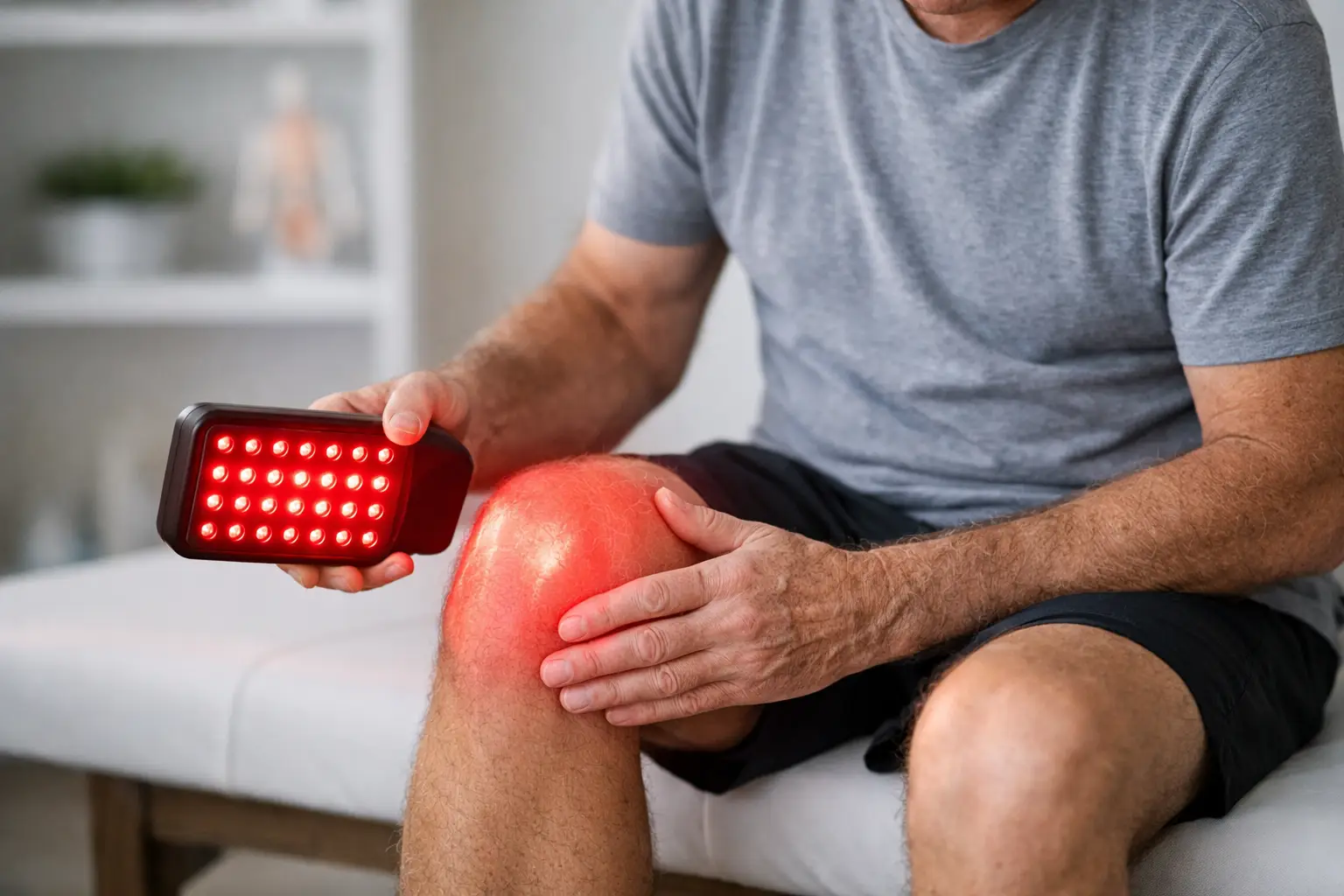
Joint pain rarely affects only a joint. A painful knee can change how you walk, disrupt sleep, limit exercise, and gradually affect mood, energy, and confidence. Red light therapy for joint pain is one option that may help support comfort and mobility, but it is most useful when it is part of a coordinated plan that considers why the pain developed in the first place.
What is red light therapy for joint pain?
Red light therapy, also called photobiomodulation, uses specific wavelengths of visible red and near-infrared light. Unlike ultraviolet light, these wavelengths do not tan or burn the skin when used appropriately. The goal is to deliver light energy to tissue in a way that may influence cellular activity, circulation, and inflammatory signaling.
For joint concerns, near-infrared light is particularly relevant because it can reach deeper than visible red light. Treatment is usually directed at the painful area, such as the knee, shoulder, hip, wrist, ankle, or lower back. Sessions are noninvasive and generally painless. Most people feel mild warmth, if anything.
The appeal is understandable: people with chronic stiffness or recurring pain often want approaches that support recovery without adding another medication or requiring extended downtime. Still, red light therapy is not a cure for arthritis, a torn meniscus, an unstable joint, or every cause of pain. Its role depends on the diagnosis, severity, daily demands, and the rest of the treatment strategy.
How light may support comfort and recovery
Cells use mitochondria to produce energy. Research into photobiomodulation suggests that red and near-infrared light may influence mitochondrial processes, including the production of cellular energy. That effect may help support tissue repair processes and the body’s response to inflammation.
For someone with joint pain, those potential effects may translate into less stiffness, improved tolerance for movement, or better recovery after activity. Some people notice a gradual change after a series of sessions rather than immediate, dramatic relief. Others experience little change, especially when pain is being driven by a structural issue, significant joint degeneration, nerve irritation, or movement patterns that have not been addressed.
This distinction matters. Pain is a signal, not a complete diagnosis. A treatment that reduces discomfort can be valuable, but lasting improvement often requires attention to joint mechanics, muscle strength, mobility, body composition, sleep, stress, and underlying inflammation.
Which joint concerns may be appropriate?
Red light therapy may be considered as a supportive option for people dealing with mild to moderate musculoskeletal discomfort, activity-related soreness, stiffness, or chronic joint symptoms. It is commonly explored by people with osteoarthritis-related knee pain, shoulder discomfort, hand or wrist stiffness, tendon irritation near a joint, and pain that limits exercise or daily movement.
It may also fit well during a recovery plan when the goal is to improve tolerance for chiropractic care, therapeutic exercise, or progressive strengthening. If pain decreases enough to make movement feel more manageable, a patient may be better able to build the stability and capacity that protect a joint over time.
That does not mean every painful joint should be treated with light alone. Sudden swelling, a hot or red joint, fever, visible deformity, inability to bear weight, new numbness or weakness, or pain following a significant injury requires timely medical evaluation. These symptoms can point to concerns that need diagnosis and treatment beyond a wellness modality.
What a treatment plan should look like
The best use of red light therapy for joint pain begins with a comprehensive assessment. The first question is not simply, “Where does it hurt?” It is also, “What is contributing to the pain, and what is keeping it from improving?”
For example, persistent knee pain may be related to arthritis, but it may also be worsened by hip weakness, limited ankle mobility, old injury patterns, excess load on the joint, poor sleep, or inflammation connected to metabolic health. Shoulder pain can involve posture and muscle imbalance, but it can also reflect a rotator cuff injury, neck involvement, or repetitive work demands.
At Quad Cities Integrative Wellness, a coordinated strategy can bring multiple root contributors into one plan. Depending on the patient, that may include chiropractic care to address movement restrictions, targeted recovery technologies, regenerative joint interventions when clinically appropriate, exercise guidance, and support for sleep, stress, weight resistance, or hormone-related factors that can influence recovery.
Red light therapy may serve as one part of that plan rather than the entire plan. This approach helps avoid the common frustration of trying a single service repeatedly while the underlying driver of pain remains unaddressed.
What to expect during and after sessions
Treatment protocols vary based on the device, the location of the joint, the depth of the tissue involved, and the individual goal. A clinician may recommend a series of sessions over several weeks, then reassess changes in pain, stiffness, function, and activity tolerance. Consistency is usually more meaningful than a one-time session.
During treatment, the light panel or device is positioned over the target area for a prescribed amount of time. Protective eyewear may be used depending on the equipment and treatment location. There is no recovery period, so patients can usually return to work, errands, or their planned rehabilitation activities afterward.
Progress should be measured by more than a pain score. Useful markers include whether you can climb stairs with less hesitation, walk longer, sleep more comfortably, return to exercise, use your hands with less stiffness, or recover more effectively after a demanding day. These functional changes help determine whether the therapy is earning a place in your care plan.
Safety and realistic expectations
Red light therapy is generally well tolerated when delivered with appropriate equipment and clinical guidance. However, “noninvasive” does not mean “right for everyone without screening.” A provider should review your health history, medications, skin sensitivity, pregnancy status, prior cancer history, and any conditions that may affect treatment decisions. Some medications can increase photosensitivity, and eye protection is essential when indicated.
It is also wise to be cautious about at-home devices. Device quality, wavelength, power output, treatment distance, and treatment time all influence the dose delivered. More is not always better. An inexpensive device may not provide the output needed for deeper joint concerns, while an overly aggressive routine can irritate sensitive skin or create unrealistic expectations.
A clinical recommendation should be based on your symptoms and goals, not a promise that light therapy will resolve every type of pain. If a joint needs imaging, orthopedic evaluation, medication management, physical rehabilitation, or a regenerative procedure, red light therapy should complement the appropriate care rather than delay it.
When coordinated care matters most
Joint pain often becomes chronic because the person has been forced to manage separate pieces of the problem in separate places. One provider addresses pain, another addresses mood, another addresses fatigue, and no one has a full view of how poor sleep, reduced activity, stress, medication changes, and mobility limitations are interacting.
An integrated model can be particularly helpful for people whose joint pain is accompanied by fatigue, weight changes, low mood, anxiety, fibromyalgia, migraines, hormone concerns, or difficulty recovering from exercise. These overlapping symptoms do not mean the pain is “all in your head.” They mean the body may need a more complete assessment and a treatment plan built around the whole person.
If joint pain is shrinking your routine, start by identifying what you want to get back to: walking the riverfront, getting through a shift without aching, playing with your grandchildren, returning to the gym, or simply sleeping through the night. Those goals can guide a personalized plan and clarify whether red light therapy is a useful next step for you.